
Summary
MPRD is built around a simple control boundary. An untrusted model generates candidate actions. A deterministic rules layer issues the evidence required for execution. The model has no direct execution capability.
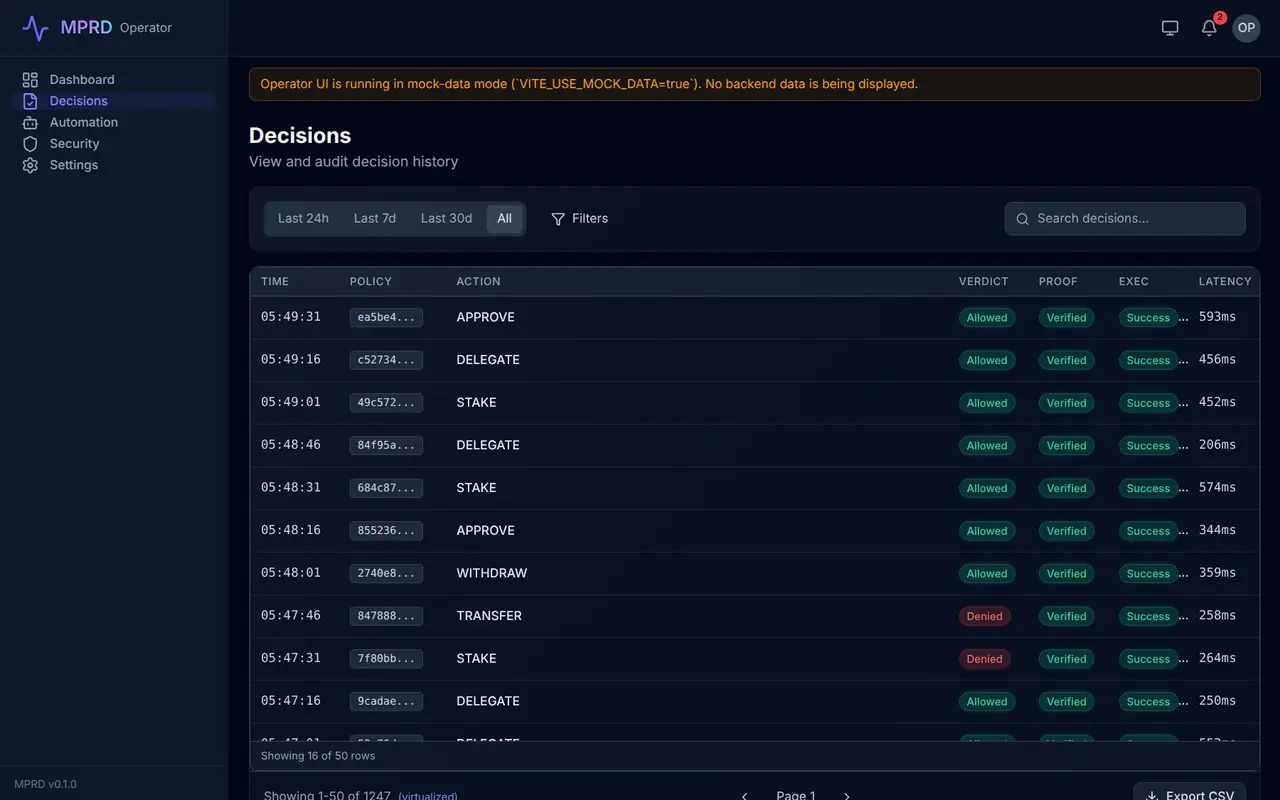
MPRD demonstrates architectural judgment: capability separation, typed execution boundaries, policy/state/action commitments, and fail-closed verifier behavior.
Start here
README.md- high-level thesis and architecture.crates/mprd-core/- core types and execution-boundary language.proofs/lean/- proofs and theorem statements.docs/RC1_BLOCKERS.md- honest remaining gaps before stronger release claims.docs/PRODUCTION_READINESS.md- implementation status and requirements before deployment.
A 10-minute review
Open the README, then inspect the core execution token / proof bundle types. Finally, read the blocker board before evaluating any high-level safety claim.
Claims and evidence
| Claim | Evidence to show | Status |
|---|---|---|
| Model output has no direct execution path in the architecture. | Executor APIs should require verified token, receipt, or ready bundle inputs. Raw model output stays outside the execution API. | Partial / architecture-level |
| Policy, state, candidate, and action commitments are part of the execution transcript. | Core types, hashes, proof bundles, verifier checks, and tests. | Partial / bounded |
| Production deployment is fully safe. | Would require complete proof chain, deployment assumptions, operational controls, and external review. | Not claimed |
What this does and doesn't establish
- A formal gate is only as good as its policy, state provenance, implementation boundary, and deployment assumptions.
- Architecture-level separation gives a bounded claim about the execution boundary.
- Strong claims should be scoped to exact modes, exact toolchains, exact threat models, and exact replay/proof commands.