
Summary
ZenoDEX works as a portfolio artifact because its assurance case is layered: functional core, verified kernels, replayable certificate layer, machine-checked proof layer, and public regression layer. Every bounded claim follows the same path from statement to inspectable evidence.
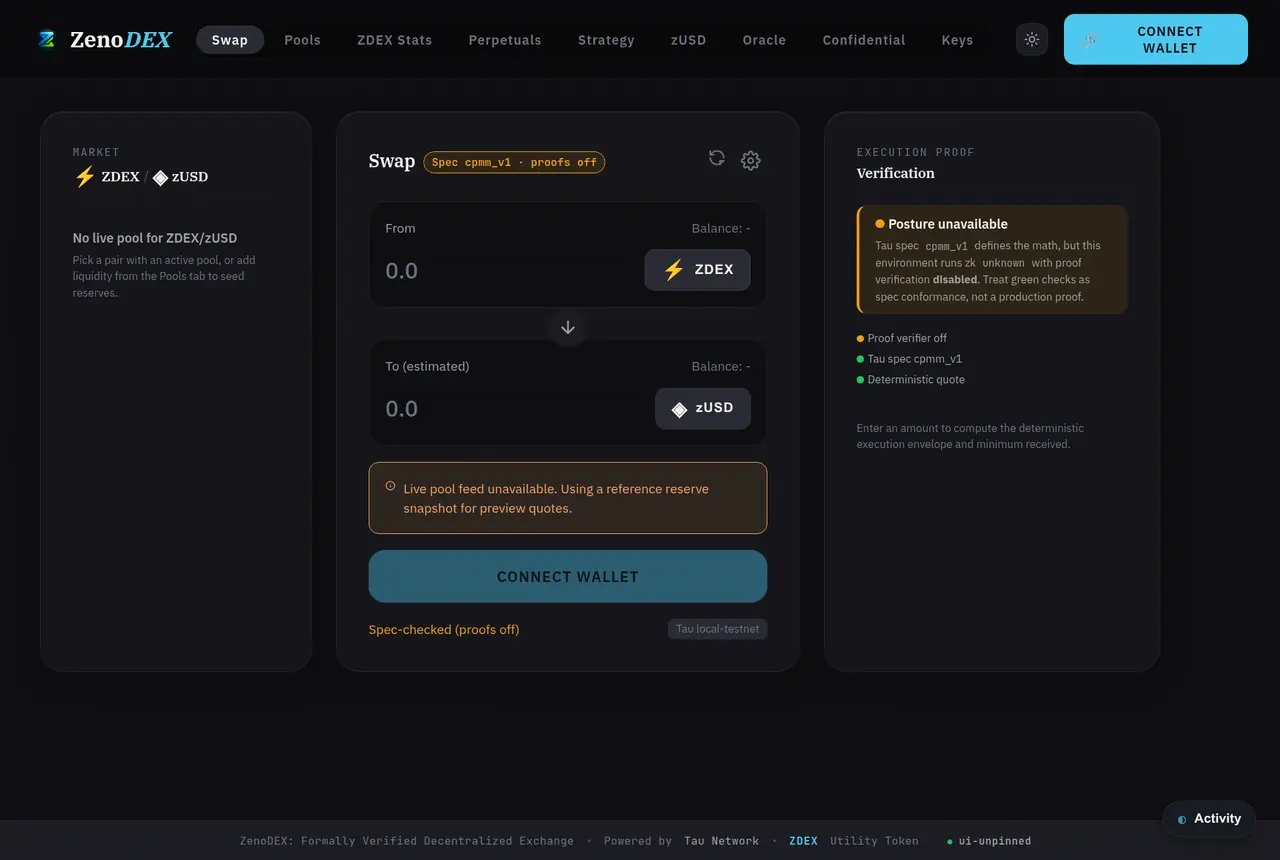
ZenoDEX demonstrates claim boundaries, public replay, negative evidence, and the difference between bounded assurance and a production guarantee.
Start here
README.md- public assurance snapshot and assurance shape.docs/PUBLIC_ASSURANCE_REPLAY.md- instructions for replaying from a clean checkout.docs/claims_registry.yaml- claim status vocabulary.lean-mathlib/Proofs/- theorem statements..github/workflows/- ratchets, hygiene, and regression gates.
Claims and evidence
| Claim | Evidence to show | Status |
|---|---|---|
| Bounded public assurance claims can be replayed from a clean checkout. | Public replay document, commands, generated receipts, and gate scripts. | Supported / bounded |
| Canonical winner properties are represented in Lean theorem statements. | Lean files around exact-in / exact-out / batch canonicality and uniqueness. | Partial / limited to stated theorems |
| All future DEX behavior is safe. | Would require unbounded proof, complete spec, deployment assumptions, and external review. | Not claimed |
What this does and doesn't establish
- Release-backed and public-replay claims have bounded scope.
- Disaster-state witnesses strengthen fail-closed assurance within the tested boundary.
- Financial/security systems need independent review before any production trust claim.